Publicly available sources provide insufficient information on patient-relevant outcomes of clinical trials

Beate Wieseler and her colleagues compared the information available in unpublished 101 clinical study reports (CSRs) with information presented in publically available sources for these trials. The CSRs provided complete information on a considerably higher proportion of outcomes (86%) than the combined publicly available sources (39%). With the exception of health-related quality of life (57%), CSRs provided complete information on 78% to 100% of the various benefit outcomes (combined publicly available sources: 20% to 53%). CSRs also provided considerably more information on harms. The differences in completeness of information for patient-relevant outcomes between CSRs and journal publications or registry reports (or a combination of both) were statistically significant for all types of outcomes.

Read more in PloS; nice coverage on AllTrials.com.

OPEN: To overcome failure to publish negative findings

The EU-funded OPEN project (Overcome failure to Publish nEgative fiNdings) brought together key opinion leaders from across Europe to address the issue of publications bias.

The key objectives of OPEN were to:

  • Identify and explore the current evidence on publication bia
  • Describe current practice by various key groups involved in knowledge generation and translation in order to provide insights on how to avoid or reduce publication bias and to identify ways to change this practice

The project is now complete and the final report summary is available from https://cordis.europa.eu/result/rcn/147610_en.html.

WORKSHOP: Reporting guidelines: a tool to increase the quality of health research published in your journal

Date and venue: 7 September 2013, 9.30 – 12.30; St Gallen 1- Swissotel, Chicago, USA (attached to the 7th congress on peer review)

Jason Roberts

Workshop outline:   

Journal editors play an important role in the dissemination of research findings and have power to considerably improve the reporting quality of research papers they publish. Some journals are already leading the way but all journals need to act in accord to raise reporting quality across all clinical areas.

Learning objectives:

  • Understand the importance of transparency and accuracy in reporting health research and be familiar with common deficiencies in reporting of randomised controlled trials (RCTs), systematic reviews and meta-analyses, and observational studies
  • Understand the key concepts of reporting guidelines and their efficient use by different professional groups with the main focus on editors and peer reviewers
  • Learn about the main elements of three major reporting guidelines: CONSORT Statement (reporting RCTs); the PRISMA Statement (reporting systematic reviews and meta-analyses evaluating healthcare interventions) and STROBE (reporting epidemiological studies)
  • Understand and efficiently use the EQUATOR Network internet-based resource centre and training programme
  • Discuss implementation of reporting guidelines in health research journals (instructions to authors, editorial and review processes, authors’ compliance, etc.)

Facilitators:

Prof Doug Altman, Centre for Statistics in Medicine, University of Oxford, UK
Dr David Moher, Ottawa Hospital Research Institute, Canada, Canada
Dr Iveta Simera, Centre for Statistics in Medicine, University of Oxford, UK
Guest speaker: Dr Jason Roberts, Managing editor, Headache, US

Programme and slides:

Programme (PDF)
Introduction, workshop agenda, learning objectives (PDF) (Iveta Simera)
Transparency and accuracy in reporting health research (PDF) (Doug Altman)
Reporting guidelines and EQUATOR resources (PDF) (Iveta Simera)
Key methodology guidelines: CONSORT, PRISMA, STROBE (PDF) (David Moher)
Implementing reporting guidelines in journals (PDF) (Iveta Simera)
Developing and implementing reporting guidelines policy: notes from a small journal (PDF), short presentation as given (Jason Roberts); long presentation (PDF) (contains helpful practical details)

Workshop participants

EQUATOR Network at the Peer Review Congress 2013 in Chicago

EQUATOR actively participated at the Seventh International Congress on Peer Review and Biomedical Publication, 8-10 September 2013, Chicago, USA.

We organised the EQUATOR workshop for editors on reporting of research studies (Saturday 7 September am) and the EQUATOR 5th Annual Lecture (Monday 9 September, 5.30 pm).

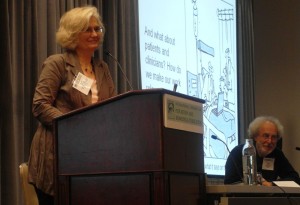
Professor Kay Dickersin, Professor at the Johns Hopkins Bloomberg School of Public Health, Director of the Center for Clinical Trials, and Director of the US Cochrane Center, delivering the 5th EQUATOR Annual Lecture at the Peer Review Congress

During the congress we talked to a large number of congress participants at our exhibition stand who wanted to learn more about reporting guidelines and EQUATOR online resources.

Handouts available from the EQUATOR Network Peer Review congress exhibition

ANNUAL LECTURE 2013: Presented by Prof Kay Dickersin

The 5th EQUATOR Annual Lecture was presented by Professor Kay Dickersin, Professor at the Johns Hopkins Bloomberg School of Public Health, Director of the Center for Clinical Trials, and Director of the US Cochrane Center (USCC).

A Wolf in Sheep’s Clothing? Limitations of Reporting Guidelines in Revealing Study Methods

Date: Monday 9 September 2013, 17:30 – 18:30
Venue: Swissotel, Chicago, USA (Peer Review Congress venue)

Lecture outline:

It is accepted that good reporting does not ensure that a study was conducted in a methodologically sound manner, and vice versa.  Indeed, reporting guidelines cannot influence those studies where no report is published at all. Until recently, we have had limited means of assessing whether a study is methodologically sound, other than depending on what is reported in the literature. In a perfect world, a clear report allows weaknesses to be detected – they are visible, not hidden. Yet knowing what is wanted by a journal or the scientific community could also lead to misreporting, either deliberately or by a lack of understanding of what is being asked for (eg, lack of understanding the concept of allocation concealment).  How best to address this issue is not clear. Making study protocols accessible is a first step but does not allow for assessment of the manner in which the research was actually conducted. In addition, is it practical to subject every study to rigorous methodological review?  And who is responsible? With the current trajectory towards open access to study data and information, and the creation of the SPIRIT Statement, a new era of reporting standards is evolving, one that goes beyond guidelines for journal reporting to making clear a study’s methodological details. The issue we must grapple with as a community is agreeing on a balance between scientific trust and scientific accountability.

Short biography:

KAY DICKERSIN, M.A., Ph. D. is Director of the U.S. Cochrane Center and Professor of Epidemiology at the Johns Hopkins Bloomberg School of Public Health, where she serves as the Director of the Center for Clinical Trials.

Kay’s main research contributions have been in clinical trials, systematic reviews, reporting biases, trials registers, and the development and utilization of methods for the evaluation of health care and its effectiveness. She has led and participated in research on reporting biases since the 1980s, most recently examining internal company documents related to the drug gabapentin and comparing the documents to the published record. She has been active in efforts to register trials, including coordination for 12 years of the Cochrane Collaboration’s CENTRAL register of reports of controlled trials, and serving as Co-Chair of the WHO’s Scientific Advisory Group for the International Clinical Trials Registry Platform. Kay has contributed to SPIRIT, PRISMA, and CONSORT for Abstracts. She has also been actively engaged in teaching, including developing courses on evidence-based healthcare, epidemiology, peer review, clinical trials and systematic reviews. Among her honors, Kay is an elected member of the Institute of Medicine in the United States.

Kay received a Master’s degree in zoology, specializing in cell biology, from the University of California, Berkeley, and a Ph.D. in epidemiology from Johns Hopkins University’s School of Hygiene and Public Health.

 

The New ICMJE Recommendations

The International Committee of Medical Journal Editors (ICMJE) has updated and renamed its “Uniform Requirements for Manuscripts Submitted to Biomedical Journals” that standardise the approach for preparation of manuscripts and that are followed by the majority of biomedical journals.

The most substantive revisions are discussed on the ICMJE website.

Read the new “Recommendations for the Conduct, Reporting, Editing, and Publication of Scholarly Work in Medical Journals” (ICMJE Recommendations)


Section 2 of the ‘Manuscript preparation’ section refers to the use of reporting guidelines and EQUATOR resources:

2. Reporting Guidelines

Reporting guidelines have been developed for different study designs; examples include CONSORT (www.consort-statement.org) for randomized trials, STROBE for observational studies (http://strobe-statement.org/), PRISMAfor systematic reviews and meta-analyses (http://prisma-statement.org/), and STARD for studies of diagnostic accuracy (www.stard-statement.org/). Journals are encouraged to ask authors to follow these guidelines because they help authors describe the study in enough detail for it to be evaluated by editors, reviewers, readers, and other re-searchers evaluating the medical literature. Authors of re-view manuscripts are encouraged to describe the methods used for locating, selecting, extracting, and synthesizing data; this is mandatory for systematic reviews. Good sources for reporting guidelines are the EQUATOR Net-work (www.equator-network.org/home/) and the NLM’s Research Reporting Guidelines and Initiatives (www.nlm.nih.gov/services/research_report_guide.htm”